Filippo Catanzariti (b. 4 June 1969, Calabria, Italy) is a civil engineer, software developer and entrepreneur.
He graduated in Civil Engineering, geotechnical track, at the University of Calabria in 1996, with a thesis entitled "Programma di calcolo per l'analisi della stabilita dei pendii con metodi numerici avanzati" (A calculation program for slope stability analysis using advanced numerical methods) - the work that became his first commercial product. He has been registered with the Order of Engineers of Reggio Calabria (no. 1839) since 1996.
From 1996 to 1999 he worked as an analyst and software developer specialising in numerical algorithms, in Pascal, Visual Basic, Fortran and Visual C++, and in full-stack web development. He works with advanced 2D and 3D mathematical models and with graphics programming in OpenGL and DirectX.
In 1999 he founded GeoStru, an international geotechnical software house whose catalogue he largely authored: slope stability and rockfall analysis, foundations and retaining structures, finite element analysis, geophysics and site investigation, hydrology and hydrogeology, and reinforced concrete design. Since 2016 he has run SC Engsoft S.r.l. in Cluj-Napoca, Romania, and he is technical and scientific consultant to GoMeeting. His most recent work is GeoStru.ai, a platform delivering geotechnical and civil calculation through natural-language conversation while keeping the analysis itself on deterministic, auditable algorithms.
Between 2005 and 2013 he co-supervised degree theses at the University of Calabria and the Mediterranea University of Reggio Calabria. He teaches accredited professional-development courses for geologists and engineers under accreditation from the Italian Consiglio Nazionale dei Geologi.
His peer-reviewed work includes papers in Green World Journal (2021), Marine and Petroleum Geology (2022), Journal of Mediterranean Earth Sciences (2022), Geosciences (2024) and Bulletin of Engineering Geology and the Environment (2026), together with memorie at the XXVII and XXVIII Italian National Geotechnical Conferences. He co-authored "Terre rinforzate" (EPC Editore, 2023) and "Terrae Motus".
He has been a member of AGI, ISRM, ISSMGE and AGI-IGS since 2014, and holds a certificate from AGS (Association of Geotechnical & Geoenvironmental Specialists).
ORCID: 0009-0001-2495-6395 - Scopus Author ID: 57936189800 - Google Scholar: ZiY1VZUAAAAJ
Maggiori informazioni sul software dedicato alla verifiche degli argini in terra. Il criterio di verifica delle opere di sbarramento di dighe artificiali descritto di seguito è valido per tutte quelle opere con altezza di ritenuta inferiore a 15 metri. Da un punto di vista statico, un giudizio globale sulle condizioni di stabilità dell’opera può dedursi…
Il Consiglio dei Ministri n.30 di venerdì 19 maggio ha approvato in esame definitivo il nuovo regolamento che semplifica la disciplina di gestione dei materiali estratti durante la realizzazione di opere edili e infrastrutture. Il regolamento semplifica la disciplina di gestione delle terre e rocce da scavo, ai sensi dell’articolo 8 del decreto legge 12…
Si avvia alla conclusione la stesura della Circolare applicativa delle Norme Tecniche per le Costruzioni da parte del Consiglio Superiore dei Lavori Pubblici. Sono infatti terminati, mercoledì 17/05/2017 i lavori del tavolo tecnico che si è occupato degli aspetti geologici e geotecnici della normativa. Dopo iniziali criticità sono state accolte le istanze e le osservazioni…
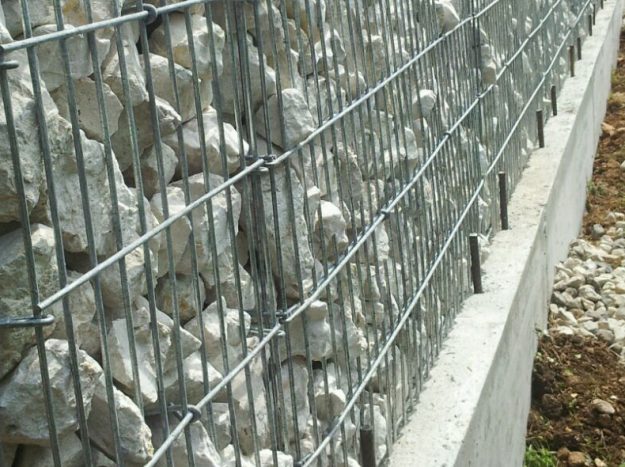
Il Consiglio superiore dei lavori pubblici ha trasmesso agli Enti e alle Amministrazioni competenti, la nota 3703/2017 avente ad oggetto la qualificazione di gabbioni e reti metalliche ad uso strutturale. Il documento specifica che: le vigenti Norme Tecniche per le Costruzioni (NTC 2008), al cap. 11, par. 11.1 stabiliscono che qualsiasi materiale o prodotto per…