Filippo Catanzariti (b. 4 June 1969, Calabria, Italy) is a civil engineer, software developer and entrepreneur.
He graduated in Civil Engineering, geotechnical track, at the University of Calabria in 1996, with a thesis entitled "Programma di calcolo per l'analisi della stabilita dei pendii con metodi numerici avanzati" (A calculation program for slope stability analysis using advanced numerical methods) - the work that became his first commercial product. He has been registered with the Order of Engineers of Reggio Calabria (no. 1839) since 1996.
From 1996 to 1999 he worked as an analyst and software developer specialising in numerical algorithms, in Pascal, Visual Basic, Fortran and Visual C++, and in full-stack web development. He works with advanced 2D and 3D mathematical models and with graphics programming in OpenGL and DirectX.
In 1999 he founded GeoStru, an international geotechnical software house whose catalogue he largely authored: slope stability and rockfall analysis, foundations and retaining structures, finite element analysis, geophysics and site investigation, hydrology and hydrogeology, and reinforced concrete design. Since 2016 he has run SC Engsoft S.r.l. in Cluj-Napoca, Romania, and he is technical and scientific consultant to GoMeeting. His most recent work is GeoStru.ai, a platform delivering geotechnical and civil calculation through natural-language conversation while keeping the analysis itself on deterministic, auditable algorithms.
Between 2005 and 2013 he co-supervised degree theses at the University of Calabria and the Mediterranea University of Reggio Calabria. He teaches accredited professional-development courses for geologists and engineers under accreditation from the Italian Consiglio Nazionale dei Geologi.
His peer-reviewed work includes papers in Green World Journal (2021), Marine and Petroleum Geology (2022), Journal of Mediterranean Earth Sciences (2022), Geosciences (2024) and Bulletin of Engineering Geology and the Environment (2026), together with memorie at the XXVII and XXVIII Italian National Geotechnical Conferences. He co-authored "Terre rinforzate" (EPC Editore, 2023) and "Terrae Motus".
He has been a member of AGI, ISRM, ISSMGE and AGI-IGS since 2014, and holds a certificate from AGS (Association of Geotechnical & Geoenvironmental Specialists).
ORCID: 0009-0001-2495-6395 - Scopus Author ID: 57936189800 - Google Scholar: ZiY1VZUAAAAJ
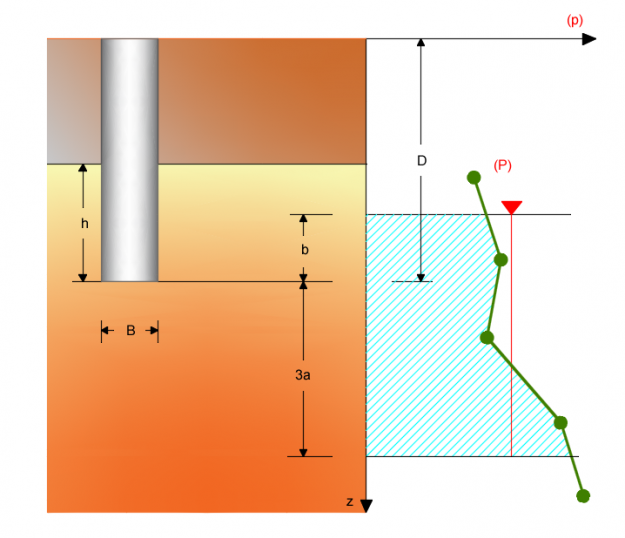
1. Charge limite d’un élément de fondation Qu Qu = Qpu + Qsu 1.1 Effort mobilisable sous la pointe Qpu Qpu= A·qu ou Qpu=ρp ·A·qu – A : section de la pointe – ρp : coefficient réducteur (cas de pieux ouverts, H, palplanches) – qu : contrainte de rupture : qu=kp· Ple* Fig 2. Schéma…
Screw-Piles Helical Anchors Soils This Guide should be used for preliminary calculations only and applies only to the deep installation of Screw-Piles and Helical Anchors in uniform soils. It is only applicable for design when the depth (D) to the top helical plate is greater than 10 times the diameter (B) of the helical plate…
Incercari de penetrometrie dinamica Calcularea valorii N60 Corelatiile recente pentru NSPT, densitate relativa si unghi de rezistenta la forfecare pentru terenurile granulare sunt prevazute cu valori ale rezistentei penetrometrice in functie de N60 (NSPT=N60 dupa Cestari, 1996) sau N1,60 valoare normalizata la o tensiune geostatica verticala de 1 bar prin aplicarea coeficientului CN (Liao Withman…
Comparatie rezultate MP vs. Exemplul de calcul 2 (Ghid de proiectare geotehnica/Proiectarea geotehnica a fundatiilor pe piloti) Prezentul document prezinta comparatia dintre rezultatele obtinute pentru calculul capacitatii portante ultime la compresiune a unui pilot armat care strabate un strat de pamant foarte compresibil in programul MP si in Exemplul 2.2 pagina 77 din Ghidul de…