
|
Software update |
|
| |
|
Slope · what’s new in 2026
Analysis scenarios, seepage
and rapid drawdown in Slope
|
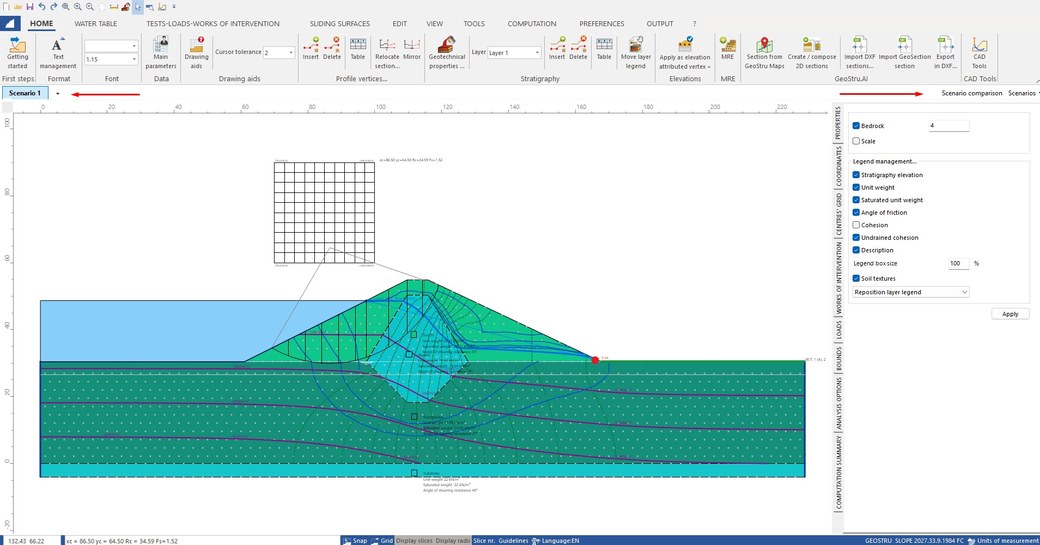
Slope on the zoned Johnson Reservoir dam: flow net and critical surface. The arrows point to the scenario bar and the scenario comparison. Click to open the manual.
|
|
Dear ,
in a stability analysis the pore water pressures often matter more than any other input, and a hand-drawn hydrostatic water table is not enough for earth dams, levees and embankments with a core. The new release of Slope computes the flow net in the section by itself and feeds it straight into the analysis, and adds the rapid drawdown check with the three-stage method. And with analysis scenarios every check of a slope lives in a single project.
|
|
Analysis scenarios: every check in a single project
Static, seismic, before and after works, with and without reinforcements: each check becomes a tab of the same project, with its own data, its own Undo and its own results. A new scenario is created in one click as a copy, or already set up as static, seismic or pre-works.
The comparison table puts method, earthquake, water table, works, minimum Fs and required Fs side by side, highlighting the outcome and the most critical scenario; “Recompute all” updates every tab at once. The report comes out as one document, with a summary and a chapter per scenario, and the DXF is exported per scenario or in a single file. Everything is saved in one project (.stapx).
How analysis scenarios work →
|
|
|
Seepage inside the stability analysis
Assign the permeability to the soil layers and Slope solves the finite element steady-state seepage: phreatic surface, flow lines, equipotentials, flow rate and exit gradient with the factor of safety against piping. One click turns the result into the pore pressure grid of the stability analysis.
Boundary conditions come from the water table, but every boundary segment can be changed by clicking it in the drawing: fixed head, no flow, seepage face, drain, infiltration. Results are checked against exact solutions and literature cases (Charny, Slide2, XSLOPE), and the comparisons are published in the manual.
|
|
|
What the new release brings
|
|
Finite element steady-state seepage — anisotropic permeability per soil layer, flow rate, exit gradient and piping check, flow net drawn in the section. |
|
Three-stage rapid drawdown — the Duncan, Wright and Wong (1990) method, the same as USACE EM 1110-2-1902: undrained strength in low-permeability materials from CU test parameters. |
|
Pore pressure grid u(x,y) — from piezometers or flow nets, importable from text files, with automatic interpolation at the base of the slices. |
|
ru coefficient and cos²θ correction — construction pore pressures per material and the correct pressure under an inclined water table. |
|
“Earth dam” model — from the start screen: section, water table, seepage and pore pressures ready in one step, then F5 for stability. |
|
A more robust analysis — the Spencer and Morgenstern-Price methods discard solutions with no physical meaning, and the DXF import reports missing layers. |
|
| Your licence is active: the new release is included in your maintenance at no extra cost. The service is renewed from your user area at 10% of the program price per year (updates and technical support). |
|
|
Download the new release
|
How to update
If you already use the version with Smart Update, just click the notification bar at the bottom: the update downloads and installs by itself, licence included. Otherwise download Slope from your reserved area, uninstall the previous version and install the new setup: from then on updates arrive by themselves. Your projects open without conversion. |
|
|
Slope on GeoStru AI too
Besides the desktop version, Slope is also available on GeoStru AI, pay-per-use straight from the browser, with nothing to install. They are two separate versions and we keep developing both.
Discover GeoStru AI →
|
|
|
In the online manual
| • |
Analysis scenarios
tabs, comparison, report and DXF of the scenarios
|
| • |
Steady-state seepage
the window step by step: permeability, boundary stretches, flow, exit gradient
|
| • |
Earth dam template
try seepage and rapid drawdown right away: the ready-made model step by step
|
| • |
Three-stage rapid drawdown
the three stages, the input data, how to read F1, F2 and Fs
|
| • |
Pore water pressures
u(x,y) grid, ru and cos²θ correction
|
| • |
Product page
details and editions in the shop
|
|
We are at your disposal for any information.
Kind regards,
The GeoStru team
|
|
GeoStru
Engsoft SRL (GeoStru) · Sarmisegetuza · 400592 Cluj-Napoca · Romania
You receive this email as a GeoStru licence holder.
Unsubscribe
|
|