|
A unified web environment for analyzing liquefaction potential from in-situ tests (SPT, CPT, Vs), supported by automatic data recognition and in compliance with current regulations. ͏ ͏ ͏ ͏ ͏ ͏ ͏ ͏ ͏ ͏ ͏ ͏ ͏ ͏ ͏ ͏ ͏ ͏ ͏
|
| |
Dear Colleague,
In geotechnical professional practice, the analysis of soil liquefaction potential in saturated granular soils under seismic conditions requires a rigorous approach and an accurate calculation of total and effective stresses. To support geologists and geotechnical engineers in these delicate design phases, GeoStru has developed Liquiter NX, an advanced web software integrated with Artificial Intelligence designed for soil liquefaction analysis.
|
|
|
|
| |
Calculation models and regulatory rigor
|
|
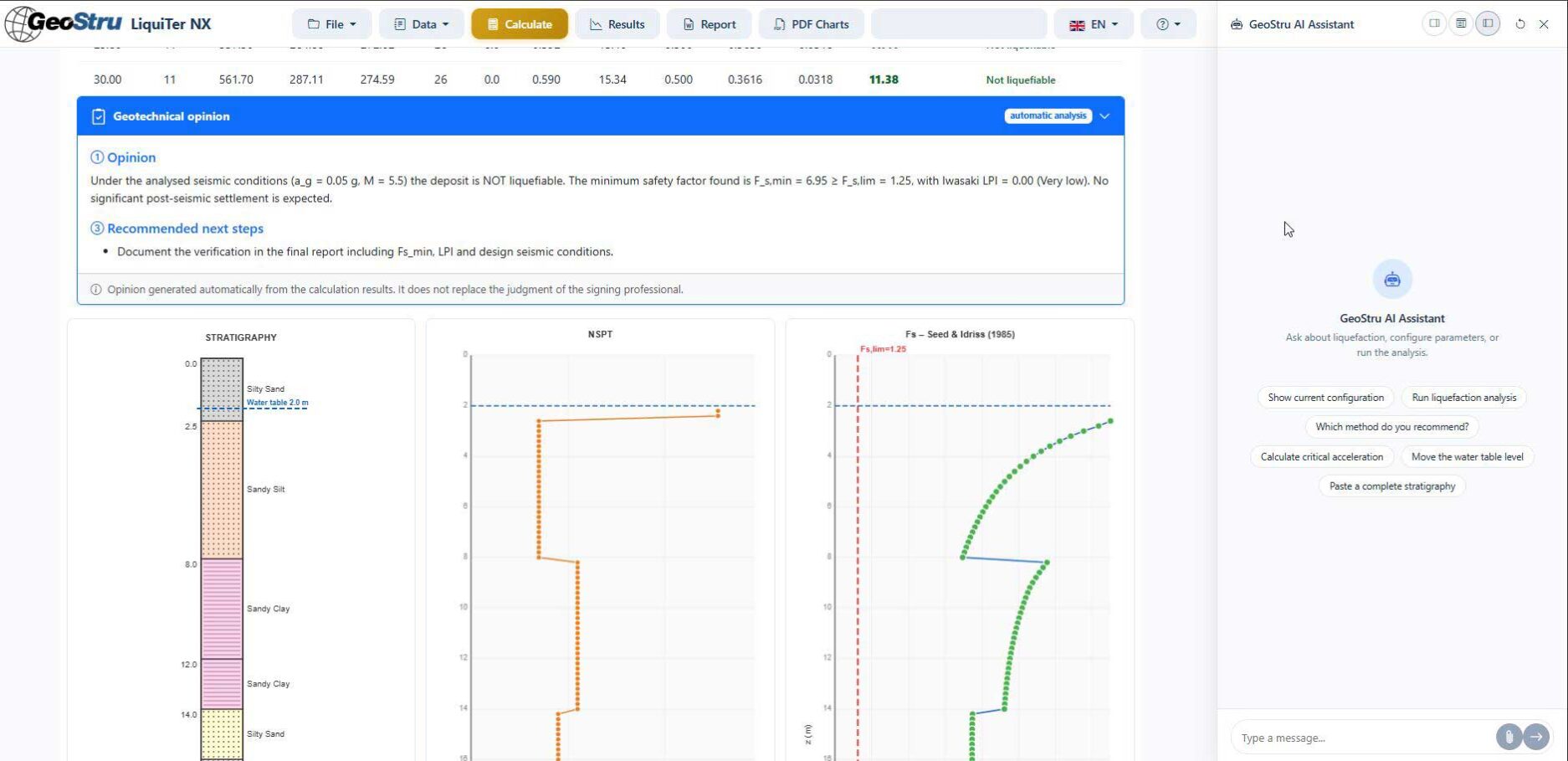
The software allows direct processing starting from the most common in-situ tests, such as SPT, CPT, CPTU, CPTE, and other geotechnical investigations. It automates the calculation of seismic acceleration and reference parameters by determining the geographic coordinates of the study area according to current regulations. Liquiter NX clearly distinguishes the above-water table zone and the below-water table zone, and proceeds with the calculation of the liquefaction factor of safety (FS) by implementing the following literature and regulatory approaches: - Seed and Idriss method (SPT data): Starting from the SPT data, the software calculates total and effective stresses, applying the overburden correction (CN) and the fines content correction (N1(60)cs). It derives the stress reduction factor (rd) to accurately determine the seismic demand (CSR) and the liquefaction resistance (CRR).
- Boulanger and Idriss 2014 method (CPT data): For this method, the software determines the normalized tip resistance and the normalized sleeve friction to evaluate the soil behavior type index. It applies the effective stress correction to obtain the corrected tip resistance (qc1Ncs), ultimately defining the CSR and CRR values.
- Andrus and Stokoe method (Vs data): In the case of the method based on shear wave velocity, the program calculates the normalized velocity (Vs1) and its critical value (Vs1c), determining the reduction coefficient (rd) alongside CSR and CRR.
|
|
|
|
|
| |
The innovation of Artificial Intelligence applied to geotechnics
One of the most innovative aspects of Liquiter NX is its integration with artificial intelligence models. It is no longer necessary to manually format complex spreadsheets: through AI, it is possible to import any type of file (e.g., XLS, CSV, PDF, or other generic formats) without providing specific instructions. The system automatically recognizes the data, identifies the necessary fields, and prepares the model for the liquefaction verification.Furthermore, the software supports natural language commands. The user can interact directly with the model, for example: - "Perform a liquefaction verification according to the code"
- "Change the SPT of layer 2 to 22"
- "Set the groundwater level to 2 m"
- "Assign to layer 2 the saturated weight of 22 kg/m³"
|
|
|
|
| |
Graphical outputs and technical interpretations
The software produces a detailed calculation report accompanied by interactive graphs that can be queried with a mouse. These allow an immediate reading of the deposit's behavior, displaying the identification of liquefiable layers, the critical depth, and the minimum factor of safety. The system can also perform automatic verifications and provide technical interpretations, determining the critical acceleration and formulating a technical opinion on the verification.
|
|
|
|
| |
🎥 To learn more about the tool's potential
| |
|
and see it in action, we invite you to watch the reference video released on the official GeoStru YouTube channel:
|
|
|
|
|


