|
Here’s how to predict the earthquake-induced displacements of embedded cantilever retaining walls ͏ ͏ ͏ ͏ ͏ ͏ ͏ ͏ ͏ ͏ ͏ ͏ ͏ ͏ ͏ ͏ ͏ ͏ ͏ ͏ ͏ ͏ ͏ ͏ ͏ ͏ ͏ ͏ ͏ ͏ ͏ ͏ ͏ ͏ ͏ ͏ ͏ ͏ ͏ ͏ ͏ ͏ ͏ ͏ ͏ ͏ ͏ ͏ ͏ ͏ ͏ ͏ ͏ ͏ ͏ ͏ ͏ ͏ ͏ ͏ ͏ ͏ ͏ ͏ ͏ ͏ ͏ ͏ ͏ ͏ ͏ ͏ ͏ ͏ ͏ ͏ ͏ ͏ ͏ ͏ ͏ ͏ ͏ ͏ ͏ ͏ ͏ ͏ ͏ ͏ ͏ ͏ ͏ ͏ ͏ ͏ ͏ ͏ ͏ ͏ ͏
|
| |
Hello ,
Today we are gonna deal with the prediction of the displacements of embedded cantilever retaining walls owing to an earthquake. Details are discussed in a recent paper published on our blog. Keep on reading, we are sure you’ll find it interesting.
|
|
|
|
| |
Displacement of Embedded Cantilever Retaining Walls due to Earthquakes
| |
|
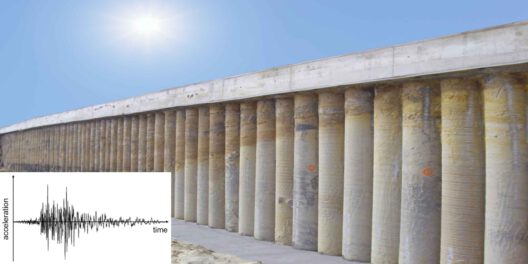
Stability analysis of embedded cantilever retaining walls in seismic area is generally carried out by calculating a factor of safety against a possible mechanism of collapse. However, a more rational approach consists in assessing the performance of the structure in terms of accumulated permanent displacement. Indeed, this approach is required by many national standards as well as Eurocode 8 Part 5 (§7.1(1)P; §7.1(2)). In this context, DReW Seismic is a software which allows readily evaluating the permanent displacement of embedded cantilever retaining walls, such as diaphragm or sheet-pile walls, after an earthquake. It is based on a method, of simple application, that performs the prediction of the permanent displacement of the wall accounting for the ground acceleration time-history. In addition, a database of acceleration time-histories is provided. DReW Seismic is simple to use and requires a limited number of input parameters. These aspects make the software quite attractive for practical applications.
|
|
|
|
|
| |
New software available: DReW Seismic
| |
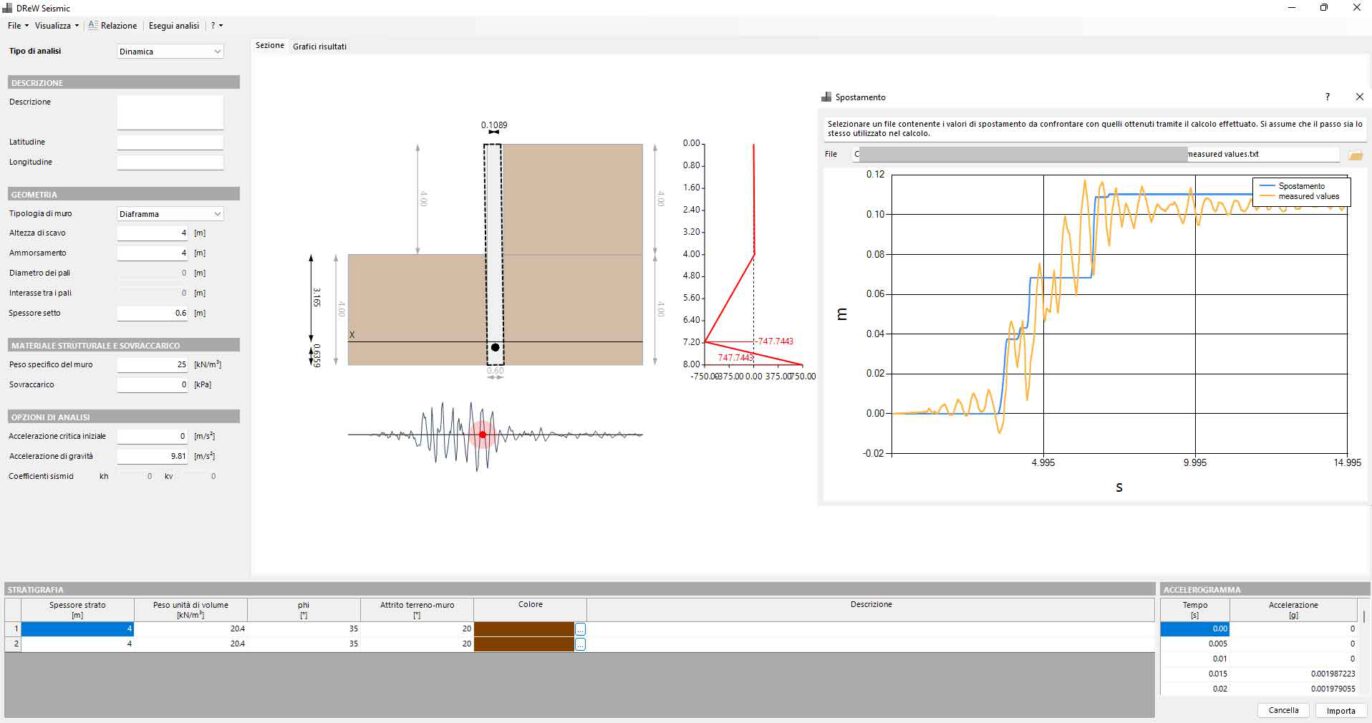
The software employed for the seismic analysis of embedded cantilever retaining walls generally calculate the wall displacement using a pseudostatic approach, in which the seismic action is schematized by an equivalent static force. Besides, the pseudostatic approach is often employed along with a Winkler-type model, in which the soil is replaced by a set of springs of assigned stiffness, that is often difficult to be estimated. Definitively, the software currently employed in engineering practice are NOT suitable to perform a seismic analysis of embedded cantilever retaining walls, based on the prediction of the earthquake-induced permanent displacement. Many national standards as well as Eurocode 8 Part 5 (§7.1(1)P, §7.1(2)) focus on approaches aimed to the assessment of the behavior of the structure subjected to an acceleration time-history, to evaluate the possible earthquake-induced displacements. In this context, DReW Seismic is developed, which allows predicting the earthquake-induced permanent displacements of embedded cantilever retaining walls, accounting for the acceleration time-history. This software is based on the method published by Conte, Pugliese and Troncone (2022) in the journal Géotechnique, which has been validated through the application to several cases well documented in the literature. The method calculates the wall displacement by solving the equation of motion, under the hypothesis that the wall rotates rigidly around a point located close to its base. The movement is triggered in the time intervals in which the acceleration exceeds a critical threshold, which is updated during the earthquake to account for the progressive development of the passive resistance of the soil below the excavation level.
|
|
|
|
|